Week 1: 6th-10th July
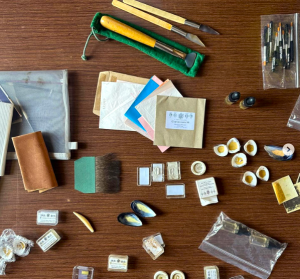
Recreating the colours on the Medieval palette: Western, Hebrew and Islamic
Instructor: Cheryl Porter
This course will study the colours (made from rocks, minerals, metals, insects and plants) that were processed to produce the paints used by artists throughout the medieval era. The focus will be on manuscript art – Islamic, Hebrew and European. Participants will re-create the colours using original recipes. Illustrated lectures will address history, geography, chemistry, iconography and conservation issues. Practical making and painting sessions will follow these lectures. No previous experience is necessary.
Biography:
Cheryl Porter is founder and director of the Montefiascone Project. She trained as a book conservator in London and has worked as a conservator, collections manager and consultant for libraries and museums in many countries, including Australia, USA, Egypt and in Europe. She was deputy Director of the Dar al-Kutub (National Library) and Thesaurus Islamicus Foundation Manuscript Project in Egypt from 2008-2011. She has published widely on the topic of colours used to paint in manuscripts and is a Professional Associate in the American Institute for Conservation.
Week 2: 13th–17th July
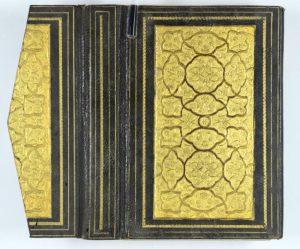
Safavid Bindings
Instructors: Fatos Aslanoglu and Marina Pelissari; lecturer: Alison Ohta
The Safavid dynasty ruled Iran, parts of the Caucasus and Central Asia from 1501 to 1722. During this period, the arts of the book flourished, with exceptionally fine manuscripts produced in royal workshops, where calligraphers, painters, illuminators and bookbinders worked in close collaboration. See for example, the Shahnama (Book of Kings) considered one of the most lavish manuscripts ever produced, which was commissioned by Shah Isma’il I (1501-1524) in Tabriz and is now scattered in collections throughout the world. Or Haft Awrang of the poet Jami produced for the Safavid prince Ibrahim Mirza between 1556-1565 and now in the Freer Gallery, Washington. These magnificent manuscripts were accompanied by equally fine bindings. Safavid binders drew extensively on Timurid and Turcoman binding traditions of the previous century, which were now refined,, producing bindings distinguished by their by meticulously planned structural systems with richly gilded ornamented covers and elaborate doublures often including delicate filigree leather work into the design.
The course will begin with an illustrated lecture introducing the historical and cultural background of Safavid book production, followed by close examination of binding components using selected examples from library and museum collections.
The class will involve the construction of a Safavid-style binding model, guiding participants through textblock preparation, sewing, endband sewing, board attachment and leather covering. Participants will also work on cover decoration using prepared tools, applying filigree techniques to better understand Safavid surface ornamentation.
This course aims to develop understanding through hands-on reconstruction and learning by making.
Instructors:
Fatos Aslanoglu is a Book and Paper Conservator specialising in Islamic manuscript material. She currently works at the British Library as Gulf History & Arabic Science Conservator, focusing on the care and treatment of rare manuscripts and historical collections. With over a decade of experience in book and paper conservation, her professional practice focuses primarily on Islamic manuscripts and significant archival collections.
She completed her academic training in Traditional Turkish Arts (Illumination–Miniature) in Istanbul, Turkey and undertook advanced studies in the same field. As part of her education, she also completed conservation modules, integrating conservation approaches into her artistic practice.
Fatos has previously worked as a project conservator at University College London Special Collections and earlier in her career at the Süleymaniye Library, contributing to the conservation of numerous Islamic manuscripts. This experience further strengthened her expertise in manuscript conservation and her commitment to the preservation of cultural heritage.
Marina Pelissari is a Book and Paper Conservator at Cambridge University Library and Archives, where she works with rare books, manuscripts, and archival collections. With a particular focus in the conservation of medieval manuscripts, Marina has developed significant expertise in preserving these historical texts and bindings. Her work combines hands-on conservation with research, ensuring the long-term preservation of cultural heritage.
Before moving to the UK, Marina gained extensive experience in private conservation studios in Brazil and Italy, where she honed her skills in the care and conservation of books and archival materials across a wide range of periods and conditions.
Marina holds an MA in Conservation from Camberwell College of Arts, University of the Arts London (2019). Her research interests include early binding structures, the mechanical principles behind historical bindings, medieval binding materials, and parchment—both its manufacture and its conservation.
Dr Alison Ohta is currently Director of the Royal Asiatic Society of Great Britain and Ireland. She completed her thesis at SOAS (London University) on Mamluk bindings and has published and lectured extensively on the subject. She is currently working on editing the catalogue of Mamluk manuscripts in the National Library of Egypt.
Week 3: 20th-24th July
Hiding in Plain Sight: Italian long-stitch bindings with secondary covers
Instructors: Maria Fredericks and Anne Hillam; guest lecture by Renae Satterley
During the early modern period in Italy, many printed books were bound using simple long-stitch structures, which could be completed quickly using basic techniques and tools. These books were sewn directly through wrappers of paper or parchment and can usually be identified by the characteristic ‘long-stitch sets’ on the exterior of the spine. However, from the late 15th century onwards, long-stitch bindings and their exposed sewing threads could be additionally covered with woodblock prints, paste-papers, parchment, cartonnage, tawed skin or tanned leather for a more decorative or durable finished binding. Through lectures and demonstrations, this course will trace the evolution of long-stitch sewing patterns and secondary coverings in Italy during the hand-press period and examine ways in which the primary wrapper could be embellished, reinforced, or even disguised. Four or more historically based models will be completed using a range of covering types and sewing patterns; modern adaptations of this useful non-adhesive structure for use in conservation bindings will also be explored. Historical examples of long-stitch bindings in the Barbarigo Seminary Library will be available for first-hand examination and inspiration.
Instructors:
Maria Fredericks is the Sherman Fairchild Head of Conservation at the Morgan Library & Museum, where she began work in 2005 as the Drue Heinz Book Conservator. She is a Visiting Lecturer in Library & Archives Conservation at the New York University Conservation Center, and a conservation consultant to the Acton Library at NYU’s Villa La Pietra in Florence. She was Head of Conservation at Columbia University Libraries 1998-2005; Principal Book Conservator at the Huntington Library 1993-98; Associate Library Conservator at the Winterthur Library 1990-93, where she established the first library conservation program, and Book Conservator at the Library of Congress 1987-90. She is a past co-director of the Paper and Book Intensive and is on the board of the Center for Book Arts in New York. She has been a regular attendee and occasional instructor at Montefiascone for over 20 years.
Anne Hillam is a book conservator in private practice providing conservation services for institutions and individuals in New York City and Western Massachusetts. She was Head of Conservation at the New York Academy of Medicine’s Gladys Brooks Book & Paper Conservation Laboratory, 2007 – 12. Anne is the Guest Lecturer for Book Conservation at the Garman Art Conservation Department at SUNY Buffalo State University, a member of the Library and Archive Conservation Education (LACE) Consortium. Anne also regularly teaches at the American Academy of Bookbinding in Telluride, CO. She has a strong interest in historic book structures, particularly parchment bindings and teaches these structures both nationally and internationally.
Dr Renae Satterley is Head of the Library at The Honourable Society of the Middle Temple, one of the four Inns of Court in London. She has been studying early modern books and libraries from 2006, with a particular focus on the founding collection at Middle Temple, the private library of Robert Ashley (1565-1641). She completed her PhD at Queen Mary University of London in 2024 and has previously worked at Cambridge University Library, Concordia University, and McGill University in Montreal. She has been cataloguing and organising the books in the Seminary library for the past sixteen years.
Week 4: 27th-31st July
A 14th century Irish Manuscript
Instructors: John Gillis, Elodie Leveque
The Red Book of Ossory is a 14th century manuscript produced in Co Kilkenny, Ireland and the property of Richard de Ledrede, controversial Bishop of Ossory from 1317 to his death in 1361. The Red Book consists of 79 pages of parchment and is written in Latin and Old French. Among its wide-ranging contents is a treatise for Aqua vitae, the ‘water of life’ or uisce beatha, today known as Irish whiskey.
The book is a large format measuring 304 x 223 x 39 mm. The manuscript contains seven quires sewn on four split alum-tawed sewing supports which are laced into quarter-sawn oak binding boards, held in place with hardwood pegs. There is evidence of primary endbands sewn on rolled alum tawed cores (now lost) being also laced into the extant boards. The boards are covered in a stitched chemise of chamois or whittawed sheepskin leather with the flesh side facing out and dyed a crimson red. Historically, this method was often employed over a more traditional leather covering but in the case of the Red Book of Ossory, it is the sole surviving covering material. The lacing pattern for the sewing supports differs between the front and back boards, the back board being a later replacement, presumably attached at the same time the first covering leather was removed. The front board has a tunnelled entry with a channel on the outside face, in a typical Romanesque manner. The back board is not tunnelled, rather the straps are set in channels and pegged on the inside, usual for Insular structures from the late 13th century. Both boards suggest a conservative approach to binding and repair given the date of the manuscript.
It is proposed to make a scaled down version of the binding. This will be an interesting exercise as the finished model will display two different board attachment traditions and the stitched-on chamise cover will be untypical, with the stained fleshside as the outer surface. The nature of the cover also allows for its removal exposing the sewing structure and lacing system beneath.
Dr. John Gillis is Chief Manuscript Conservator and Project Manager at Trinity College Dublin Conservation Department. In 1988 he established and worked as Head of Conservation in the Delmas Conservation Bindery at Archbishop Marsh’s Library, Dublin. John has taught book conservation techniques and theory in Italy for over twenty-five years. He lectures both at home and abroad and has been published in several journals and books. His major achievement to date has been the conservation of the Faddan More Psalter, a medieval manuscript retrieved from a bog in 2006, and conserved at the National Museum of Ireland Conservation Department over a four-and-a-half-year period, for which he won the Heritage Council of Ireland Conservation Award in 2010. In 2021 he published a monograph on the Psalter detailing the art history, conservation, codicology, palaeography and materiality of the manuscript.
John has twice been a resident scholar in the Getty Research Institute in Los Angles and has lectured widely in the United States while carrying out his research.
Dr Élodie Lévêque completed a PhD in Medieval History in 2020 at Université Paris Nanterre (Paris X) and holds a Master’s degree in Book Conservation from the Sorbonne (2010). Her research focuses on Carolingian and medieval bookbindings from France. She is currently Associate Professor of Book and Paper Conservation at Sorbonne University and a member of the Institut de Recherche et d’Histoire des Textes (IRHT, CNRS). She is the Principal Investigator of an ANR-funded project on 3D imaging of medieval bindings and was previously a postdoctoral researcher on the ERC-funded Beasts to Craft project. Before her current appointment, she worked as a Senior Conservator at the National Library of Ireland and at Trinity College Dublin, and as a Research Engineer at the Institut de Recherche et d’Histoire des Textes (IRHT/CNRS) in Paris. She was previously a Manuscript Conservator at Montpellier University Library. From 2010 to 2016, she worked at the National Library of Ireland as a Project Conservator and Heritage Council Fellow, where she conserved the Library’s manuscript collections, including the Gaelic and Ormond Deeds collections. She was also a Gladys Brooks Book and Paper Fellow at the New York Academy of Medicine (2010), and completed postgraduate internships at the Morgan Library & Museum and the San Francisco Museum of Modern Art (2009–2010).